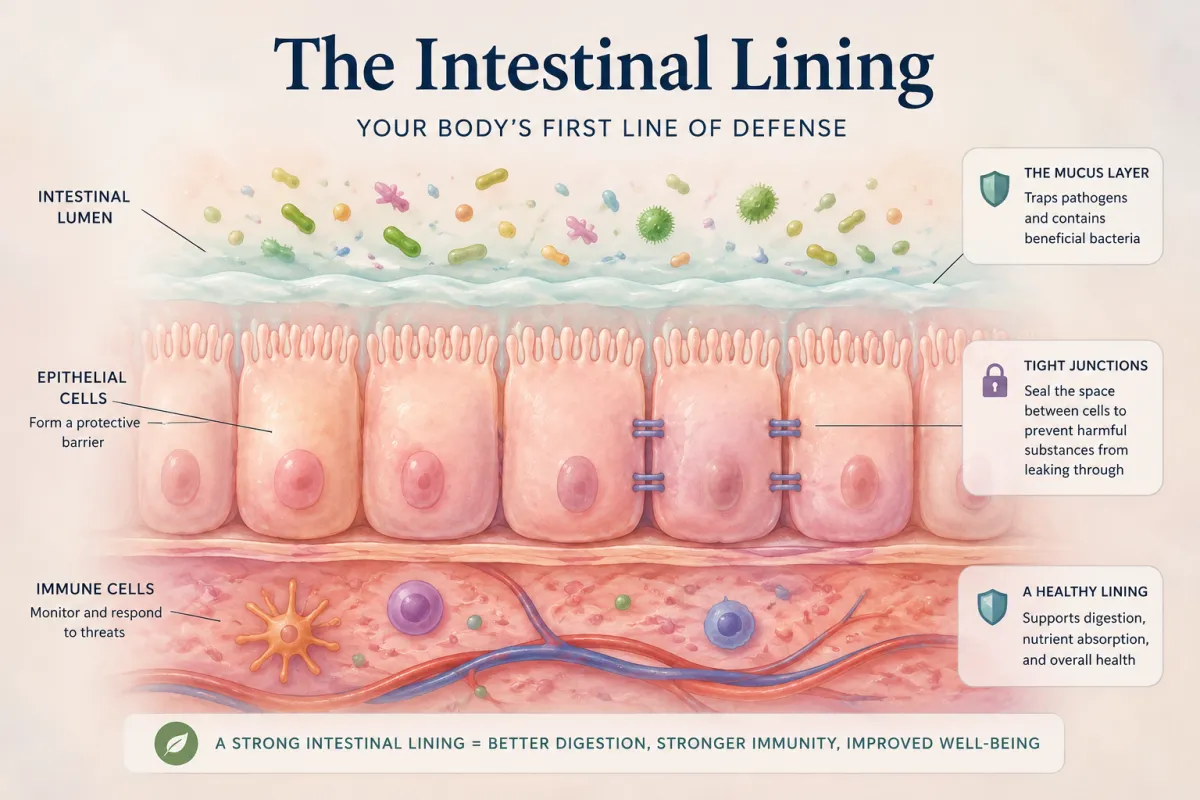
The Intestinal Lining
Where Your Immune System Meets the Outside World
Most people think of the gut as a digestive organ. A place where food is broken down and nutrients are absorbed.
But the gut has another equally important task:
Every day, it must decide what can come close to the body and what needs to be kept at a safe distance.
This work takes place in the intestinal lining. It is a sophisticated boundary where gut bacteria, food, immune cells and the body’s own tissues meet.
When the intestinal lining functions well, this happens almost unnoticed. But when the balance is disrupted, it can affect far more than digestion alone.
The intestinal lining is not just a passive layer
The intestinal lining consists of several protective layers that work closely together.
The outermost layer is mucus, produced by specialised cells known as goblet cells. In the colon, this mucus is primarily composed of a protein called MUC2.
The mucus layer does more than provide lubrication. It helps create physical distance between the bacteria in the gut and the cells lining the intestinal wall.
Further out in the mucus layer, microorganisms can find nutrients and live as part of the gut ecosystem. Closer to the intestinal wall, the environment is much more protected.
This is an important balance:
Bacteria should be present in the gut, but they should not have unrestricted access to the body’s tissues.
A barrier only one cell thick
Beneath the mucus lies the intestinal epithelium. It consists of a continuous, single layer of cells held closely together by structures commonly known as tight junctions.
These cells perform a remarkable double duty.
They must absorb water and nutrients while limiting access to unwanted substances and microorganisms.
The intestinal barrier is therefore not a sealed wall. It is an intelligent and selective interface.
Its cells are continuously renewed, and different cell types perform different functions. Some produce mucus. Others release antimicrobial substances. Others detect signals from the contents of the gut and communicate with the immune system.
The best immune system does not attack everything
The gut’s immune system faces a difficult task.
It is constantly exposed to foreign proteins from food and enormous numbers of microorganisms. If the immune system reacted aggressively to everything unfamiliar, the gut would remain in a constant state of inflammation.
A well-functioning immune system is therefore not simply one that responds powerfully.
It must also be able to distinguish between different types of signals.
Immune cells in and around the intestinal lining must learn to tolerate ordinary foods and beneficial microorganisms while remaining able to respond to harmful bacteria, viruses and other threats.
The intestinal lining also produces secretory IgA. This is an antibody that can bind to microorganisms and help keep them at an appropriate distance from the intestinal wall.
At the same time, immune cells monitor the area and exchange signals with both epithelial cells and gut bacteria.
A healthy state is therefore not immunological silence. It is a controlled and precise conversation.
Gut bacteria are part of the conversation
The gut microbiome is not simply a collection of passive passengers.
When bacteria ferment dietary fibre, they produce substances including short-chain fatty acids. These compounds can be used as energy by cells in the colon and are involved in signalling processes that affect both the intestinal barrier and the immune system.
This does not mean that everyone should eat exactly the same foods or consume the largest possible amount of fibre.
If your digestive system is already sensitive, increasing fibre too quickly may cause additional discomfort. The amount, type, pace of introduction and your individual tolerance all matter.
The relevant question is therefore not only whether a food is considered “healthy”.
It is also:
How does your body respond, and what pattern does that response reveal?
What can challenge the intestinal lining?
The intestinal barrier can be affected by many different factors. Infections, persistent inflammation, alcohol, smoking, certain medications, nutritional deficiencies and significant changes in the microbiome may all play a role.
Stress and sleep can also influence digestion and the communication between the nervous system, immune system and gut.
However, it is important not to turn “leaky gut” into a universal explanation for every symptom.
Increased intestinal permeability is a genuine biological phenomenon that researchers can examine in certain diseases and circumstances. But it is not a single diagnosis that automatically explains fatigue, skin problems, bloating or hormonal symptoms in everyone.
A symptom tells us that something may need to be investigated. On its own, it does not reveal the underlying cause.
How you can support your gut’s defences
There is no single food or supplement that can “repair” the intestinal lining on its own.
The most relevant foundations are often more practical:
Eat a varied diet containing fibre from sources you tolerate.
Increase fibre gradually if your digestive system is sensitive.
Make sure you consume enough energy, protein and micronutrients.
Prioritise sleep, movement and regular meals.
Avoid smoking and limit high alcohol consumption.
Take medication as agreed with your doctor, and seek professional advice if you are concerned about side effects.
Investigate persistent symptoms instead of repeatedly trying to suppress them with changing diets or protocols.
Blood in the stool, unexplained weight loss, persistent diarrhoea, fever, severe pain or symptoms that wake you at night should always be assessed by a doctor.
The Root Method™ looks for the pattern
The intestinal lining clearly demonstrates why the body can rarely be understood one symptom at a time.
Digestion, the immune system, the nervous system, nutrition, the microbiome and lifestyle all influence one another. This does not mean that everything begins in the gut. It means that the connections deserve to be explored.
In The Root Method™, we therefore do not begin with the question:
“Which supplement matches this symptom?”
We begin with questions such as:
When did the symptoms begin?
What causes them to return?
Which systems appear to be involved?
What has already been tried?
What should be investigated and prioritised first?
The body rarely needs the greatest possible number of solutions.
It needs us to ask better questions.
Would you like help understanding your overall symptom pattern?
During a Root Test Consultation, we begin with your individual situation and create greater clarity about which next step makes sense.


